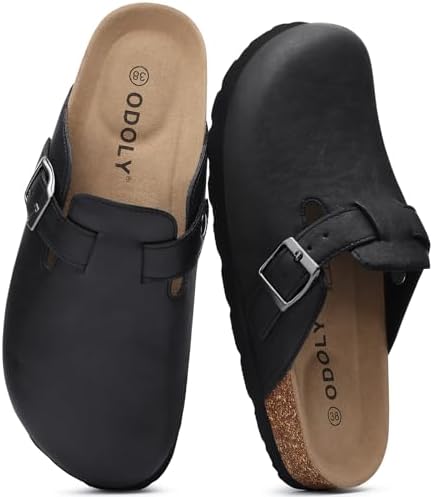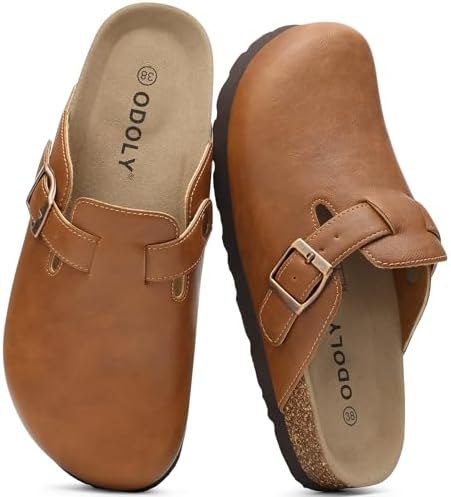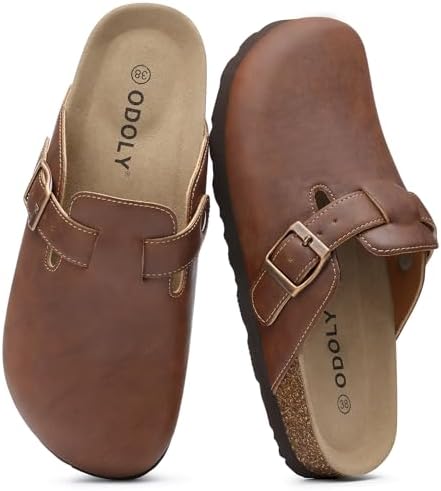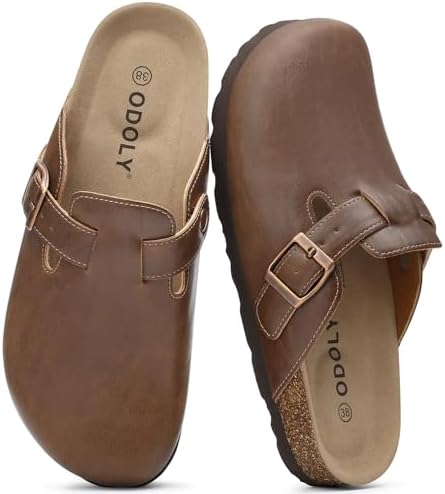
Closed toe backless clogs shaped in distressed vegan leather, fitted with a copper-tone buckle and our cork footbed.
$29.99
★★★★☆ 4.4 (302)
A backless mule leaves the counter off entirely. With no strap behind the heel, the shoe stays in place through two surfaces: the vamp across the instep and the cup under the heel. When the foot lifts, the bed drops away and catches the heel on the way back down.
A shoe with no back has no counter to grab the heel. That leaves two contact points to keep the shoe with the foot as you walk. The first is the vamp, which wraps across the instep and takes the forward pull of the stride. The second is the heel cup in our moulded cork footbed. The cup holds the rear of the foot between its raised edges. If the vamp sits too loose, the foot slides forward into the toe box. If the cup is too shallow, the heel drifts sideways off the cork rim.
On a closed shoe, a shallow cup works because the counter holds the foot over the bed. On our backless mules, the heel cup is cut deeper into the cork. The wall of the cup rises around the rear of the heel to give it a definite seat. That ridge keeps the foot from sliding left or right when the heel comes down. We mould the cork footbed with this wall so the heel lands in the same hollow with each step. The cork takes the shape of the foot with wear, deepening that seat further over time.
The stride in a mule is different from the stride in a lace shoe. When your knee moves forward, your heel lifts clear off the cork bed. The shoe hangs from the instep for an instant while your weight rolls through the ball of the foot. As the sole meets the floor, the heel comes back down into the cup. The footbed has to be waiting in the right place. A stiff outsole helps keep the bed flat under the foot so the heel cup does not twist away while airborne.
Look at where the upper meets the top of the foot. The vamp should reach back over the bridge of the instep, not stop short near the toes. If the upper has a strap and buckle, the strap belongs over the highest point of the instep where it can pin the foot to the footbed. Check the rear rim of the cork bed as well. The edge should stand proud behind your heel with a clear border, so your heel sits inside the hollow rather than over the raised lip.
A mule is lasted for walking at an ordinary pace across a floor or down a street. It is not built for running for a train or climbing over loose ground. When you run, the foot leaves the footbed faster than gravity brings the shoe along, and the vamp cannot pull the heel back into the cup. Tightening the buckle by an extra punch hole will not turn a mule into a laced shoe. It only binds the upper against the instep without fixing the open rear.
The mule works when the vamp covers the instep and the heel lands cleanly inside the cork cup. Check the position of the buckle and let the heel cup do its job. We last each backless pair to keep that balance steady on the foot.
Written at our bench. Every pair we mention is sold through our retail partner, who sets the price and handles payment, delivery and returns.
Backless mules in smooth and vegan uppers, held by the vamp and a deep heel cup.
Closed toe backless clogs shaped in distressed vegan leather, fitted with a copper-tone buckle and our cork footbed.
Black vegan upper on a cork footbed with memory foam, a copper tone buckle and an open back for quick slip on wear.
Caramel brown vegan uppers lasted with a broad closed toe, an antiqued copper pin buckle, and our moulded cork footbed.
Distressed vegan uppers in deep habana brown, lasted on our cork footbed with an adjustable copper-tone vamp buckle.
Our workshop builds every shoe on one moulded cork footbed across the catalogue.
Every shoe we build begins with the same moulded cork footbed, but the first choice at the bench is the front of the upper.
A shoe takes its internal volume and width directly from the solid form we build it over.
Answer four questions about the foot, the toe and the upper, and we will narrow the shelf down for you.
Find my pairBack to the shelves