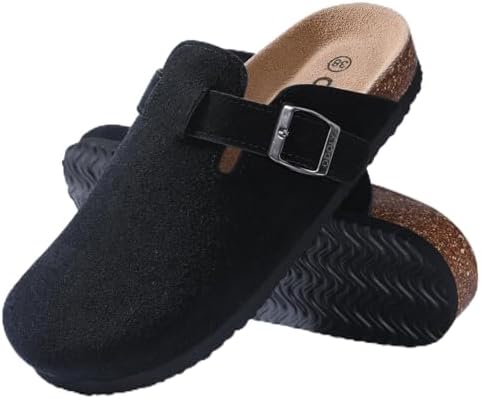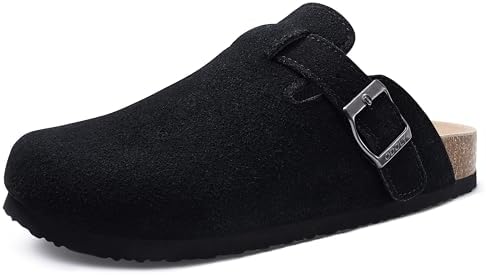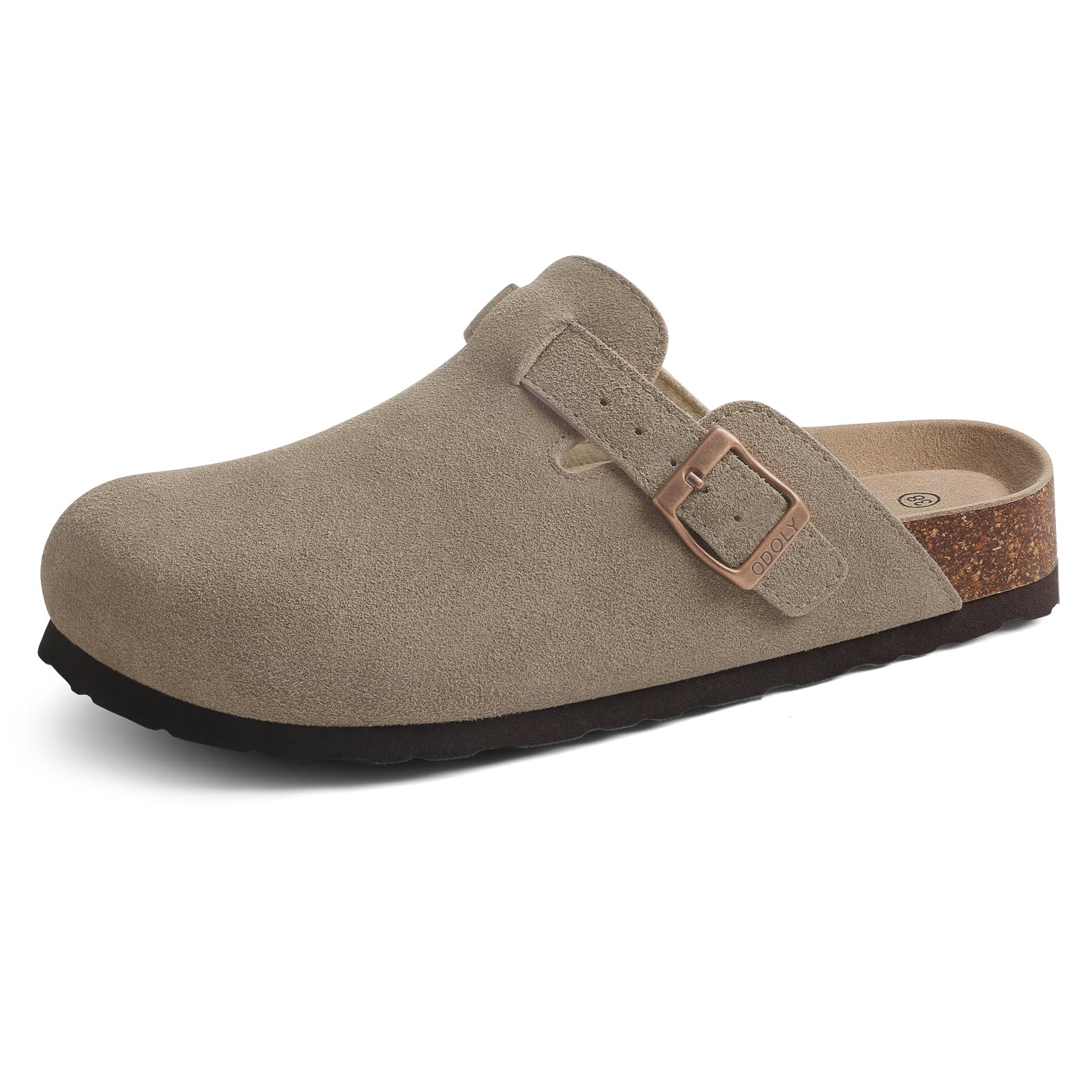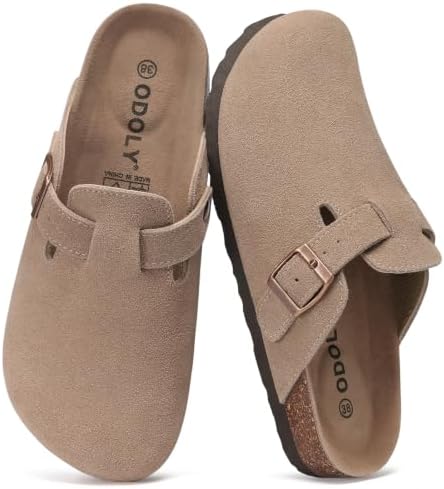
We last this closed toe clog in taupe suede over our contoured cork footbed with an adjustable metal buckle.
$46.99
★★★★★ 4.5 (3,767)
Our workshop builds every shoe on one moulded cork footbed across the catalogue. The bed is pressed with a deep heel cup and a raised curve beneath the instep. It feels rigid when it leaves the bench, but the material settles under weight over a week of wear.
The bed begins as granulated cork pressed into a firm shape before we cement the upper. We build a high rim around the edges, a deep heel cup at the back, and a raised contour along the medial side. An EVA outsole sits underneath to take the grit from the road. The cork itself stays firm enough to hold its geometry when you step down, yet the material yields slowly under the heel and the ball. That balance gives the bed its structure. If the cork were softer, the arches would flatten within days. If it were harder, the surface would never take an imprint.
A fresh cork footbed feels flat across the top grain despite the moulded contours. The surface needs heat and the steady press of your step to begin shifting. Over the first week, the grain compresses where your weight sits hardest. The heel sinks slightly into the cup, and the crest under the arch softens into the exact curve of your foot. We suggest wearing a new clog or sandal in short stretches at first. The cork needs time to yield, and the suede lining needs to settle against the insole before the pair flexes naturally with your stride.
A backless clog or slide needs a mechanical stop to keep your foot in place. That is the function of the heel cup. Because the rim rises around the back of the bed, the heel settles into a pocket rather than sliding off the rear edge. As you walk, the cup holds the foot over the footbed so the toes do not travel forward into the toe box. The upper vamp and the adjustable strap over the instep work together with this pocket. When the buckle holds the upper snug, the heel stays seated in the cup through every step.
Cork holds a shape well, but it has distinct physical limits. Water is the primary risk for this construction. If a cork footbed gets soaked, the pressed granules swell, the bonding agent softens, and the moulded contours lose their definition. Heavy moisture also ruins the bond between the cork midsole and the EVA outsole. Keep the cork dry to preserve the shape. If the edge gets dirty, use a dry brush or a barely damp cloth along the exposed rim. Never submerge the bed or leave it drying near high heat.
Once cork compresses under one person, that impression is permanent. The material compacts beneath the heavy contact points and stays there. If another person puts on a worn pair, their heel and toes fight the existing hollows in the bed. The shoe will feel uneven and awkward underfoot because the cork cannot reset its shape. That is why an old pair belongs to one person alone. The suede upper may stretch to fit a different instep, but the compressed cork beneath the lining remains fixed to the first foot that wore it.
The exposed cork along the side of the shoe needs basic maintenance to keep its shape. Clear away dry dirt with a stiff brush around the edge. If the cork gets wet, let the pair dry in open air away from direct heat. The pressed bed will retain its shape for the life of the upper.
Written at our bench. Every pair we mention is sold through our retail partner, who sets the price and handles payment, delivery and returns.
Closed toe clogs and mules cut from brushed suede, buckled across the vamp and lasted over our moulded cork footbed.
We last this closed toe clog in taupe suede over our contoured cork footbed with an adjustable metal buckle.
Black suede lasted over a moulded cork footbed, closed at the toe and buckled over the instep.
Black suede closed toe clogs shaped over a natural cork footbed with an adjustable vamp buckle.
Dark grey suede cut over a round toe, lasted onto our moulded cork footbed with an antiqued metal buckle across the instep.
Every shoe we build begins with the same moulded cork footbed, but the first choice at the bench is the front of the upper.
A shoe takes its internal volume and width directly from the solid form we build it over.
A backless mule leaves the counter off entirely.
Answer four questions about the foot, the toe and the upper, and we will narrow the shelf down for you.
Find my pairBack to the shelves